Fractions of a Shape
Circles, bars, triangles and hexagons cut into equal parts, to name or to shade.
Shapes divided into equal parts with a fraction to write, or a fraction given and the parts to shade in. Every cut is made by area: a rectangle split into eighths comes out four by two rather than eight slivers, a triangle is cut from its point to its base, and the hexagon is only offered for halves, thirds, sixths and twelfths because those are the only sectors of a hexagon that are genuinely the same size. Turn on equivalent pairs and each question shows one shaded shape beside an empty one cut into more parts, to be shaded to match — the first real step towards equivalence. The number line adds the same fraction in the form children need for the rest of their schooling.
- Age
- ages 5–12
- Answer key
- Included, free
- Skills
- arithmeticlogicvisual discriminationproblem solving
What you can change
What the child does
Name it, Shade it, Both, Part of a group
Parts allowed
2, 4, up to 6, up to 8, up to 12, Halves, Thirds…
How many shapes
2–12 shapes
Unit fractions only
Shapes
A mixture, Circles only, Rectangles only, Strips only, Triangles only, Hexagons only
Equivalent pairs
Number line
- Every page also takes the book's language, page size, theme and pictures.
Ready-made worksheets with this page
Used in 20 worksheet sets for the school year, each in its country's language.
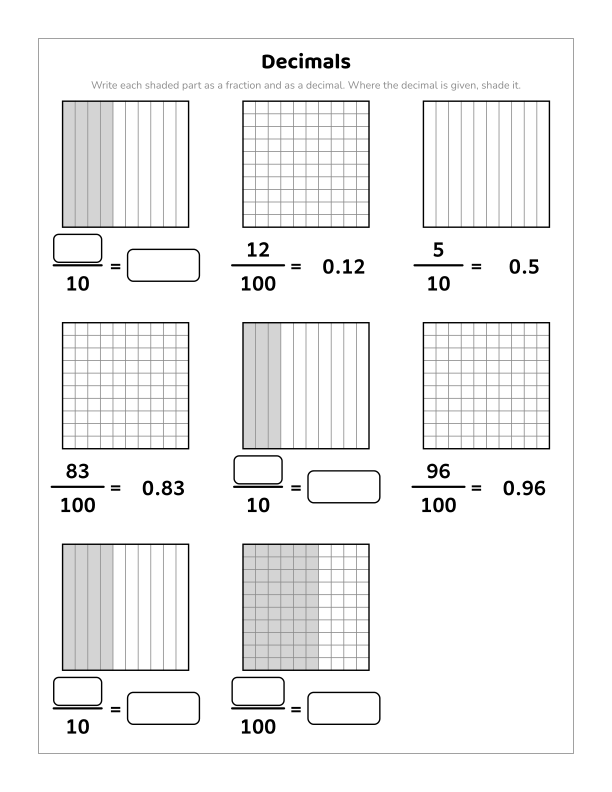
🍕 Fractions and decimals
All activities →Halves and quarters of a shape, then tenths and hundredths.
Put it in a book with other pages: covers, answer keys and a certificate are free.
Start building